First day cover ·
iPhone Duo Teardown: Better Repair Marks, Costly Fold
iFixit gives Apple's iPhone Duo a provisional 5/10 for repairability, its highest foldable score yet, but the $999 inner screen and early hinge failures stand out.
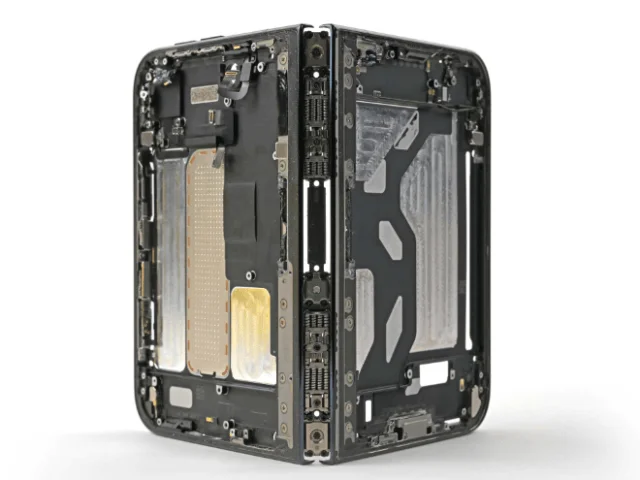
Apple's first foldable is in the hands of repair technicians, and the early findings are a mix. The iPhone Duo earns a provisional 5 out of 10 for repairability from iFixit, the highest score the site has given any foldable smartphone. Yet the same teardown lands on a problem that's already showing up in the field: early owners report cracks and bright lines along the fold, sometimes within hours of unboxing. Out-of-warranty inner-screen damage costs $999 to fix.

Where the Duo Scores Well
Most of the repairability credit comes from design choices Apple has used on iPhones for years. The batteries release cleanly thanks to electrically debonding adhesive, so technicians don't need aggressive prying to remove them. The outer screen and trim come off intact, and the disassembly path is fairly flat. That gives access to the cameras, the modular USB-C port and other components without pulling the whole phone apart.
The batteries sit in metal shells, roughly 7.5 Wh and 11.6 Wh, for a combined 19.1 Wh. The logic board is a single-layer design, which iFixit notes hasn't appeared on a recent iPhone since the iPhone 8 era. Apple published a repair manual on day one, which helps. The score is still provisional, though, because it depends on how fully replacement parts become available through Apple's self-service repair program.
iFixit's team was clear that the score isn't a recommendation to tinker casually. The inner folding screen is the expensive, slow part of any repair. It's delicate adhesive work that could take a typical do-it-yourselfer several hours, even with proper fixtures. A full inner-display replacement is the $999 job. The flexible polymer cover layer with the matte nano-texture is a much smaller bill, at $49 without AppleCare and $19 with it.
Hiding the Crease Takes Some Doing
No foldable has fully erased its crease, and the Duo doesn't either, despite marketing that describes it as nearly "creaseless." Under magnification, the nano-texture finish looks like tightly packed rounded bumps, a bit like bubble wrap. Those bumps scatter light and soften reflections, which helps disguise the dip along the fold. Remove that cover layer, and the crease becomes far more obvious. iFixit says it looks more visible than on a Galaxy Z Fold 8 in a side-by-side comparison. The surface underneath also scratches more easily, so the cover layer is doing real work.

The display itself has a few more tricks. Some red, green and blue subpixels are oval and sit at varying angles instead of forming a regular grid. An Apple patent describing ways to reduce diffraction artifacts in polarizer-free displays covers this kind of geometric dithering. The idea is to divide the screen into regions with different patterns, with up to 32 displacements, so optical artifacts don't reinforce each other and pull the eye toward the fold. Gaps in the pixel pattern also make room for the inner selfie camera, whose photos iFixit describes as somewhat muddy.
The Hinge, the Dust, and the Early Failures
The hinge uses the waterdrop approach common across modern foldables. The screen curves gently inside the mechanism instead of folding into a sharp crease when closed. A chain of metal joints, which iFixit likens to a watchband, works with springs, curved guides and synchronization gears to control the bend. Together they reduce stretch and squeeze on the display layers and let the phone hold intermediate positions. An accordion-style flex cable carries signals through a gap in the hinge. Apple's patents describe more than ten ultrathin layers and adhesives designed to glide as the phone folds.
Glow-dust testing, which uses particles finer than beach sand but representative of everyday grit, showed the IP68-rated Duo is better sealed than some rivals. Fewer particles reached the internals or hinge than in earlier Galaxy Z Fold 8 or Pixel foldable tests. That isn't the same as dust-proof, though. Enough grit still got into the hinge to produce an audible crunch, and dust also turned up in the USB-C port, the speaker mesh and the bezel areas. Cleaning or servicing the hinge means removing the flexible display and its supports first.
The failure reports follow a pattern. Owners describe a pop or crunch during opening or closing, then a small line on the fold and bright lines across the display. The damage tends to cluster near the transition between the flex-cable gap and the central hinge support. Using teardown footage, patents and CT scans, iFixit built a 3D model of the hinge. One hypothesis is that a center support bar doesn't drop fully when the phone closes, creating a local stress hotspot where the curved display presses against it. A stuck center pivot or nearby components could also play a part. Separately, a localized electrical fault can black out an entire row or column of pixels even when there's no obvious external damage. iFixit presents these as hypotheses, not confirmed causes.
What I'd Take From This
For a first-generation foldable, the Duo gets several things right. The electrically releasable batteries and easy-to-reach outer parts are real improvements, and they put the phone ahead of earlier foldables on iFixit's scale. But the inner screen and hinge are still expensive and labor-intensive to fix. The early failure reports are clustering in one high-stress zone, and dust can still reach the mechanism. Conventional phones, and repair-focused devices such as certain Fairphones, still score higher overall.
If you're considering the Duo, AppleCare+ coverage is worth a close look, and the fold deserves careful handling. That's especially true around dust and repeated folding. Apple is replacing many affected early units free of charge under the standard one-year limited warranty, according to the report. If yours develops a problem, document it with photos and a timeline, note that the damage appeared without any impact, and take the phone to an Apple Store with the receipt and box if you have them. The situation is still changing, since the device has only been on sale for a few days. Watch whether Apple's self-service parts program fills in, because that will decide whether the provisional 5/10 score holds up.
The full teardown, with images, video, microscope shots and the 3D hinge model, is on iFixit's site.