First day cover ·
Mac Studio M5 Ultra at $29,799: Where the Price Actually Comes From
Apple's top M5 Ultra Mac Studio, with 512GB of memory and 16TB of storage, costs $29,799. Most of that premium is memory, and the buyer case is narrow.
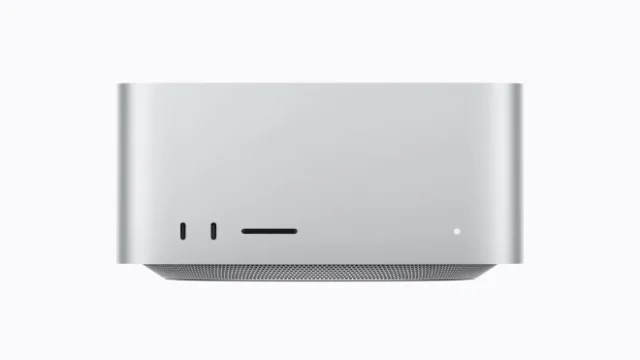
Apple has opened orders for the top configuration of its M5 Ultra Mac Studio, and fully loaded it lands at $29,799. Most of that figure comes from one line item: 512GB of unified memory. If you're weighing whether this machine makes sense, start there, because the chip is strong but the memory decision is what turns this from an expensive desktop into a very specialised tool.

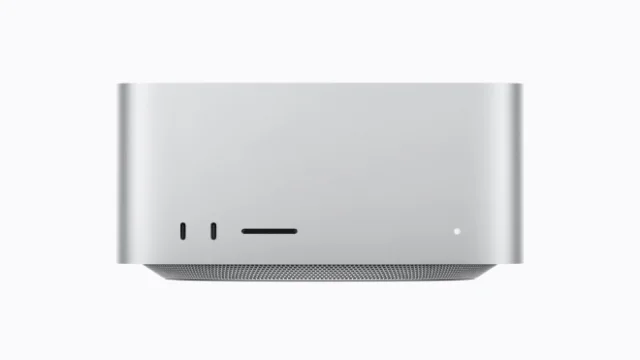
What's inside the M5 Ultra
The M5 Ultra is a quad-die design. It fuses two dual-die M5 Max chips through a next-generation UltraFusion interconnect, so the system treats them as a single system-on-chip. The top variant carries a 36-core CPU, made up of 12 super cores and 24 performance cores, paired with an 80-core GPU and a 32-core Neural Engine.
The GPU is where Apple's pitch gets interesting. Apple describes it as its most powerful silicon GPU to date, and for the first time on an Ultra chip, every GPU core includes Neural Accelerators. Apple claims up to 4.3 times the peak AI compute of the previous M3 Ultra and up to 9.8 times that of the M1 Ultra. Those are vendor figures, so treat them as direction rather than a measured result for your workload. Graphics also gets third-generation hardware-accelerated ray tracing and enhanced shader cores.
The memory is the real story
The 512GB unified memory option is available only with the 36-core CPU / 80-core GPU version of the M5 Ultra. It delivers 1.2TB/s of bandwidth, which Apple puts at 50 percent higher than the prior generation. That memory is shared across the CPU, GPU and Neural Engine, so a model loaded once is reachable by all three without copying it around.
Apple's positioning is clear: run very large language models entirely on the device. The company talks about keeping hundreds of billions of parameters resident in memory. The practical upside is that you stop metering tokens and stop paying ongoing cloud inference bills, and your data never leaves the desk. Here's the thing, though: capacity alone doesn't make a model fast. Bandwidth matters for how quickly the machine can feed those parameters to the compute, and that's where the 1.2TB/s figure does its work. Whether that translates into usable speed for your particular model depends on quantisation, context length and your software stack, none of which the spec sheet settles.
The media engine has also been expanded, with twice the video encode and decode blocks of the M5 Max. Apple says it can handle simultaneous playback of up to 33 streams of 8K ProRes 422 at 30 fps, with hardware support for H.264, HEVC, ProRes and AV1 decode.

Who this is actually for
This is a narrow buyer profile. AI researchers, data scientists and developers working with frontier-scale local models or fine-tuning large datasets are the clearest fit, because the combination of memory capacity, bandwidth and Neural Accelerators lets them keep big models resident and private.
Post-production and 3D work fits too. VFX artists and filmmakers who grade or composite uncompressed 8K timelines in real time, and 3D artists and game developers who rely on ray tracing and a high GPU core count for real-time visualisation, are the other obvious customers. Musicians, photographers and software engineers with very large multi-track sessions, huge image libraries or long compile and test cycles can also justify the spend.
For everyone else, the lower configurations will do the job. Even the M5 Max models, which top out at 128GB of memory, cover a lot of professional work without the Ultra premium. My read is that most people looking at the $29,799 build are better served by the cheaper configurations, and the fully loaded machine is a purchase driven by a specific workload that already can't run elsewhere.
What the price breaks down to
The base M5 Ultra Mac Studio starts at $5,499, with a 30-core CPU, 64-core GPU, 96GB of memory and 1TB of storage. Moving to the 36-core CPU / 80-core GPU chip adds $1,300. The 512GB memory upgrade alone costs $15,500, which takes a 1TB configuration to $22,299. The maximum 16TB SSD adds another $7,500, bringing the total to $29,799.
The memory premium stands out. Apple's previous 512GB option on the M3 Ultra was priced at $4,000, so the new tier costs close to four times as much. Apple's pricing for high-capacity memory reflects how expensive that memory is to source and how few buyers need it. Expect that gap to matter in comparisons with rented GPU time and workstation builds, though those comparisons depend heavily on how many hours you run.
The 512GB configuration began taking orders in late October 2026, with deliveries expected from late November into early December. You can see the exact configuration on Apple's Mac Studio store page.
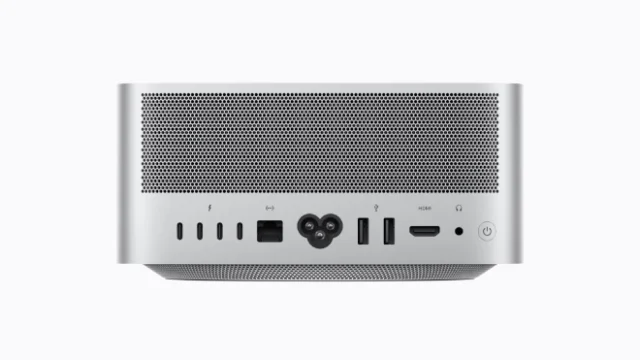
Connectivity and clustering
Expansion is strong across the range. The Mac Studio offers up to six Thunderbolt 5 ports, each capable of 120Gb/s, along with Wi-Fi 7 and Bluetooth 6 via Apple's N1 chip, HDMI, and support for up to eight external displays. Storage uses a new SSD architecture that Apple says is up to twice as fast as the previous generation, and the fully loaded build tops out at 16TB.
Clustering is the more interesting long-term angle. Multiple Mac Studios can be linked over Thunderbolt 5 with RDMA to pool memory for larger distributed inference jobs. Apple has demonstrated clusters of four systems delivering up to 3 times the inference performance of a single machine. That's a route to bigger models without buying one enormous box, and it's worth modelling if your team is already thinking about multiple machines.
Should you buy it?
If your work genuinely needs half a terabyte of high-bandwidth memory and the top of Apple's silicon stack, the fully loaded Mac Studio is now available at a price that reflects both its performance and the current cost of high-capacity memory. For most readers, the honest answer is to pick a smaller configuration and spend the difference on time saved or a second unit later. What to watch next is independent benchmarking of large local models on the 512GB build, because that's where Apple's memory-first pitch will either hold up or need qualifying.