First day cover ·
Bluetooth 7.0's HDT Mode Targets Lossless Audio, but 7.5 Mbps Is a Ceiling
Bluetooth 7.0's optional High Data Throughput mode lifts the PHY rate to 7.5 Mbps, but that's a ceiling, not a promise of lossless sound. Here's what buyers should know.

Wireless audio has spent years piling on codecs, each with its own logo and its own list of compatible phones. Qualcomm has aptX Lossless, Sony has LDAC, and Apple takes its own route. If you've ever tried to work out which pair of headphones will actually use the best connection your phone supports, you know how tangled that gets. Bluetooth 7.0 could be the first real attempt to fix this at the transport layer rather than with yet another codec.

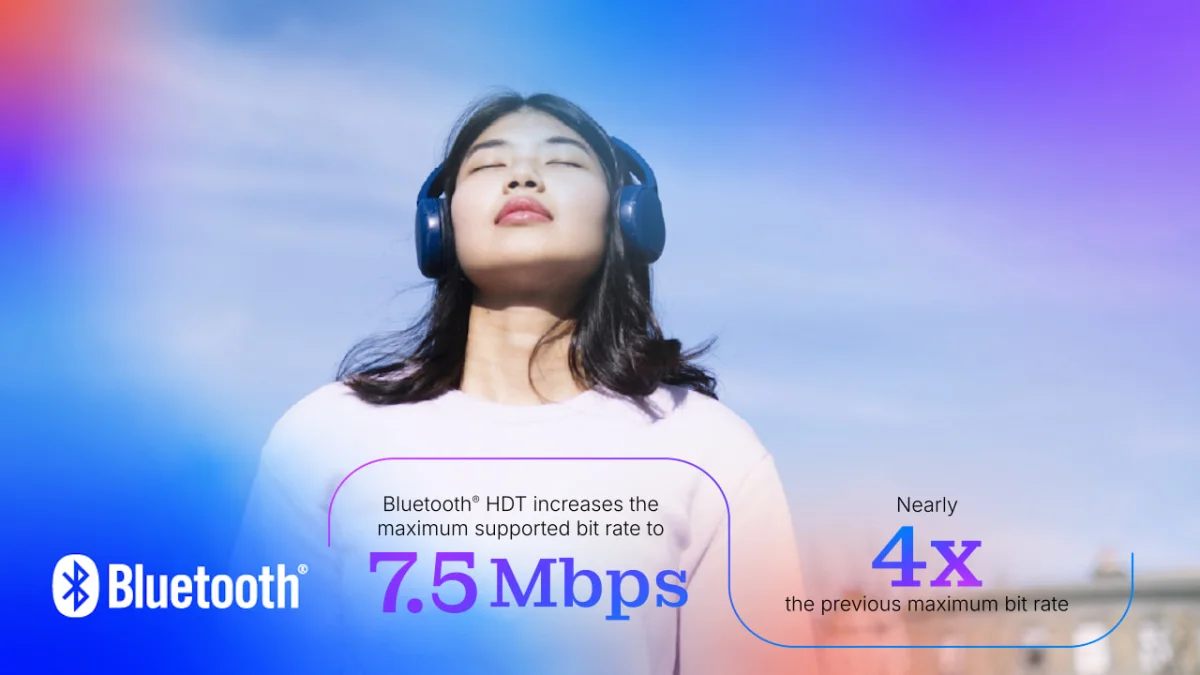
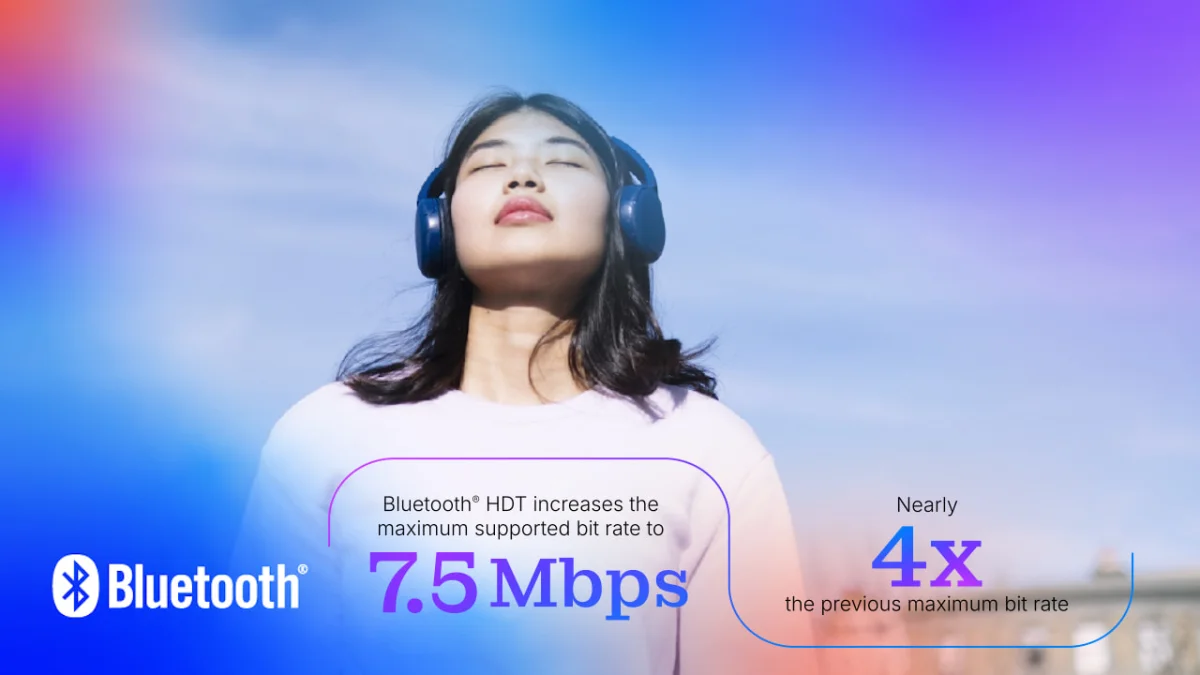
The Bluetooth Special Interest Group (SIG) has adopted Bluetooth High Data Throughput (HDT), announced on November 4, 2026. It's a Bluetooth Low Energy enhancement that raises the maximum physical-layer bit rate from 2 Mbps to 7.5 Mbps. HDT is an optional feature in the new Bluetooth Core 7.0 specification, and the SIG expects standardized lossless and high-resolution wireless audio built on it to arrive in 2027.
The headline number is impressive. The fine print is where buyers should look first.

What HDT actually changes
HDT doesn't bolt a faster mode onto the existing radio. It introduces a new physical layer with more advanced modulation, forward error correction and reworked packet handling. The aim is to move more data per transmission while improving spectral efficiency and reliability, and potentially energy use too. Compatible devices get the extra headroom; older hardware doesn't gain it by updating its Bluetooth number on the box.
The standard defines five transmission rates, but they don't all carry the same weight. Per the SIG's specification summary, the required HDT rates are 2, 3 and 4 Mbps. The optional rates are 6 and 7.5 Mbps. The modulation schemes are π/4 QPSK, 8PSK and 16QAM, and the error protection is forward error correction, running on a Bluetooth Low Energy architecture.

Here's the catch: 7.5 Mbps is the maximum physical-layer rate, not the bandwidth you get for music. A manufacturer can implement HDT and skip its two fastest modes entirely. Protocol overhead then trims whatever is left. So when a headphone box says HDT, the useful question is which rates it supports.
Why the numbers matter for lossless audio
Uncompressed stereo at 16-bit/44.1kHz needs roughly 1.41 Mbps. Push that to 24-bit/96kHz and you're looking at about 4.61 Mbps before transmission overhead. Those figures help explain the appeal. Even the required 4 Mbps tier clears the high-resolution requirement on paper, with less room for error than the 7.5 Mbps ceiling suggests.
In practice, though, a faster radio doesn't create a lossless audio standard on its own. You still need an audio encoding scheme, a profile that describes how that audio is carried, and an implementation that handles it cleanly. Think of HDT as a wider pipe. It doesn't decide what flows through it.
Where it sits next to today's codecs
Today's options work differently. Qualcomm's aptX Lossless can deliver CD-quality audio under suitable conditions. LDAC supports higher sampling rates but remains a lossy codec. Those trade-offs are why many buyers end up matching a specific headphone to a specific phone.
Qualcomm is also pushing a separate route. Its Snapdragon Sound Elite Gen 2 platform, as Qualcomm has described it, pairs Bluetooth with low-power Wi-Fi 6E and XPAN technology for more demanding wireless audio and extended range. That approach may stay relevant after HDT arrives, especially for high-bandwidth audio that needs more than a Bluetooth link can offer.
What makes HDT interesting to me is the possibility of a broadly adopted premium standard instead of another vendor-specific badge. The SIG expects that standardized premium wireless audio on HDT will cover lossless audio, high-resolution playback, multichannel surround and spatial audio. If that holds, headphone makers get a shared foundation, and listeners stop having to check a compatibility chart before every purchase.

What to keep in mind before buying
- Bluetooth 7.0 doesn't guarantee HDT. It's optional, and manufacturers have to implement it deliberately.
- HDT isn't a codec. It upgrades the transport. Audio encoding and profiles still have to be supported on both ends.
- Existing headphones won't get it through a software update alone. Support depends on the underlying radio hardware and firmware.
- Lossless wireless isn't arriving this year. The SIG points to 2027 for the first standardized premium audio applications, and actual products depend on manufacturers.
- Raw throughput doesn't settle everyday performance. Battery life and connection stability in crowded wireless environments still matter, and a higher maximum rate doesn't fix those by itself.
HDT also shouldn't be confused with Bluetooth LE Audio or Auracast. LE Audio already uses the efficient LC3 codec, and Auracast lets compatible devices receive audio broadcasts without conventional one-to-one pairing. HDT addresses bandwidth. LE Audio and Auracast address efficiency and sharing. They can coexist, and a headphone could in principle use several of them.
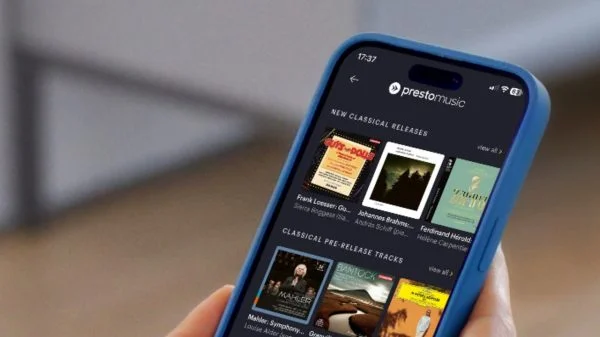
There's also a source-device problem. A pair of headphones can support advanced codecs while the phone or laptop doesn't, and the connection falls back to something less capable. Standardization could help, but both ends still need to speak the same version of the technology.

My read
Bluetooth HDT could end up being the most consequential wireless audio development in years. Not because every listener needs 7.5 Mbps to enjoy music, since most of us don't, but because the industry gets a common foundation for more ambitious audio. The SIG's own materials also point beyond headphones, toward faster wearable synchronization, more capable peripherals and spatial computing gear.

For audiophiles, the bigger question is whether Bluetooth 7.0 can make lossless wireless listening less dependent on proprietary codecs and carefully matched hardware. That will depend on manufacturers choosing which HDT rates to implement and how quickly they ship. If you're buying headphones in the next year, check the supported rates and codecs on the spec sheet, not just the Bluetooth version. The specification is a real step forward, but it becomes useful to buyers only once products that work together start reaching shelves.

For more information, see the Bluetooth SIG.