First day cover ·
MacBook Pro Goes Touch and Lighter: Apple's Tom Boger on the Design Trade-Offs
Apple's Tom Boger explains the weight cuts, the touch-enabled PROLED XDR display, and the return of the glowing logo on the new MacBook Pro, starting at $2,899.
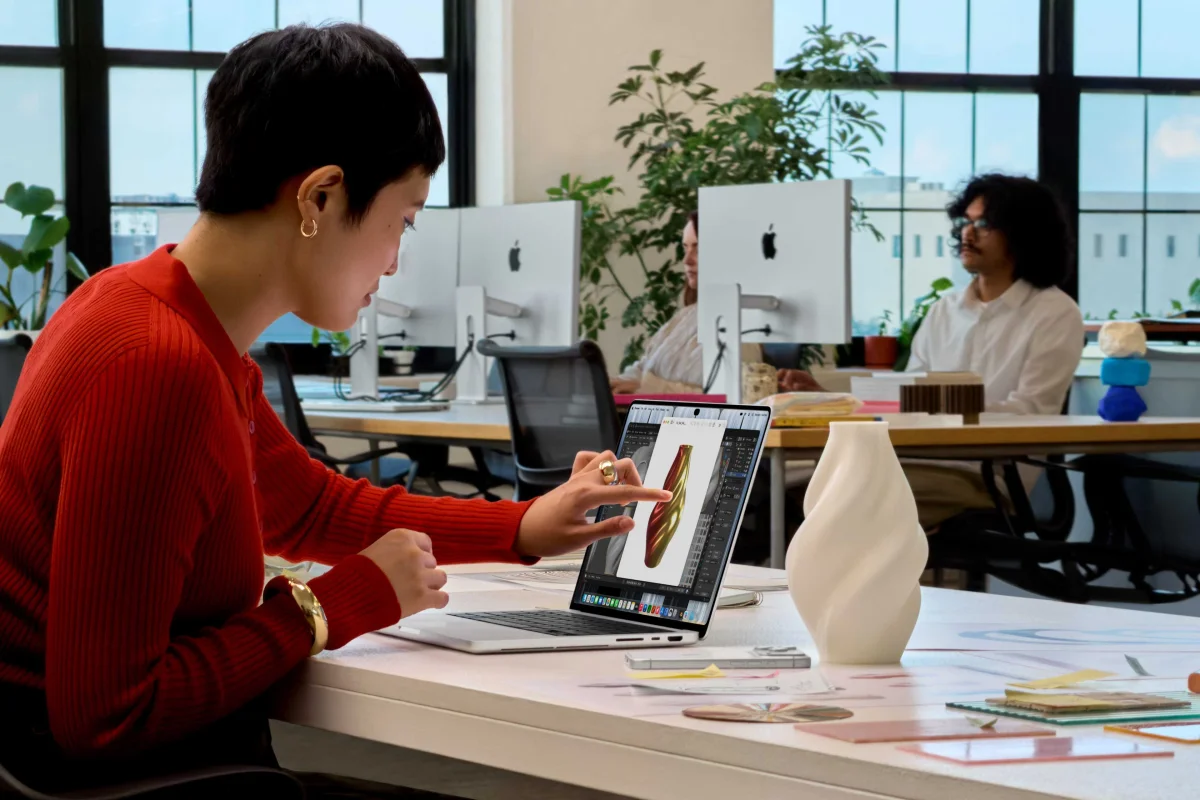
Touch on a Mac has been a long-running argument, and Apple's new MacBook Pro with PROLED XDR Display settles it on Apple's terms. The notebook is lighter and thinner than before, it has a reference-grade touch display, and it brings back an illuminated logo on the lid. I spoke with Apple's Vice President of Mac and iPad Product Marketing, Tom Boger, to find out how the team reasoned through those choices. The spec sheet tells you what changed. Boger's answers explain why, and where Apple chose not to budge.
Shaving weight one component at a time
The 14-inch model is about half a pound lighter than its predecessor, and the 16-inch is about 0.7 pounds lighter. Boger didn't point to a single breakthrough. He said the team went through every component in the machine looking for grams to remove, and he described it as "a thousand things" rather than one big change.
That approach is harder than it sounds. Removing material from a part can weaken it, change how it behaves, or push problems onto a neighbouring part. Boger's framing was that each component had to stay as functional as before. "You have to make sure you're not compromising the integrity of whatever component you're taking the weight out of," he said. Of everything Apple did on this product, he named the weight work as the place where "you really have to sweat every little detail."
My read: for anyone who carries a laptop daily, half a pound on a 14-inch machine is the kind of difference you feel on a train or in a bag. It's also the kind of gain that's easy to claim and hard to verify without a side-by-side with the old model, so I'd want to handle it in person before deciding it matters.
A display that sets the pace, and touch that stays out of the way
Boger called the display the headline feature. It's a tandem OLED panel that stacks two electroluminescent layers, which Apple says delivers a 10,000,000:1 contrast ratio and up to 2,000 nits of brightness. Self-emissive pixels are there to cut the blooming and halo effects that show up around bright objects on many other displays. Boger was blunt about where Apple sees itself: "There's literally nothing else in the industry like this." He also credited Apple's display engineering team as "one of, if not the best in the world," and said building a panel like this takes years and then has to be manufactured at scale.
The touch layer is the part that will split opinions. Boger's position is that the MacBook Pro is still a trackpad-and-keyboard machine first. The touch support is an addition, not a redesign, which is why the Mac's interface didn't get reworked around fingers. He argued that the new panel is more responsive than touch on other laptops and that it moves less when you press it. I haven't tested that claim myself, so treat it as Apple's view until you've tried it.
What Boger considers new is the pairing of touch with a machine far more powerful than an iPad Pro, which he said "opens doors" for creative software. He also made a generational argument: people who have used touch on phones and tablets for their whole working lives are now entering jobs, and he sees a touchscreen Mac as a natural fit for them.
Apple has published a technical white paper on the PROLED XDR Display for readers who want the engineering detail. Read the white paper to see how the panel is built.
The glowing logo comes back
The illuminated Apple logo is back on the lid after roughly a decade away, and Boger was clearly pleased to talk about it. He turned his demo Mac so we could both see it, and said reception at launch had been strong. The detail I found most interesting is that the logo is reflective. With the mirror-like finish intact, a closed Mac shows the logo as a shiny, mirror-black mark.
Boger wouldn't explain how it works. "That's something we're going to let be the mystery and the magic of this implementation," he said. Pressed again, he said only that Apple has fantastic engineers and "it's just magic." I won't pretend that's a satisfying answer for a reviewer, but it does tell you the company treats this as a finished design detail rather than a technical talking point.
His reason for bringing it back was about the relationship with the owner. "People's lives are on their Mac," he said, and people take pride in them. He described the revival as happening in "a much more elevated way." That's a sentiment, not a spec, but it's a useful signal of how Apple wants this machine to be seen.
Enterprise pitch: cost, reliability and local AI
Analyst Horace Dediu recently drew on Apple's financial results to suggest that Apple may have outsold Dell last quarter. Boger didn't address that directly. He did say the Mac has never been more popular and has never held a higher market share across its history. He claimed the company is bringing in more new-to-Mac customers than at any point in the Mac's 42 years, and he credited the MacBook Neo as a major driver of that momentum.
In the enterprise, Boger argued that Macs are cheaper to support, more reliable, and better liked by the people using them. "It can save an enterprise money if they put a Mac in the hands of their employees," he said. The argument is that happier users are more productive and support costs drop.
Boger tied that to Apple Silicon, pointing to fast, low-latency unified memory as a key difference. Then he made the AI case. Cloud AI usage means paying for tokens, and running the same models on-device avoids that cost. He said that for enterprise users, a Mac can "pay for itself in a matter of months." That claim depends heavily on workload, model size, and how much cloud spending a company is doing now, so I'd treat it as a hypothesis to test rather than a fixed payback period.
Creative work, and what it costs
Boger's closing pitch was about creative professionals. The idea is that higher-end applications can now be combined with touch "in ways that it hasn't been combined before." He said people using MacBook Pros "literally change the world," and the hope is that touch helps creators do more of their best work. He tied that back to Steve Jobs's description of the computer as "a bicycle for the mind."
The bicycle isn't cheap. The MacBook Pro with PROLED XDR Display starts at $2,899. See the MacBook Pro with PROLED XDR Display for current configurations and pricing.
Here's the thing: the most interesting bit of this Mac isn't the touchscreen itself. It's the way Apple is treating touch as an add-on to a trackpad-first machine, and betting that professional users will find it useful rather than distracting. The real test will come when creative apps and enterprise workflows start to show how often people reach for the screen.