First day cover ·
Apple Music's hidden 404 page turns into a playable 25th-anniversary iPod
Apple's Music site hides a browser-based first-gen iPod behind an invalid URL, complete with a click wheel and a nested Brick game.
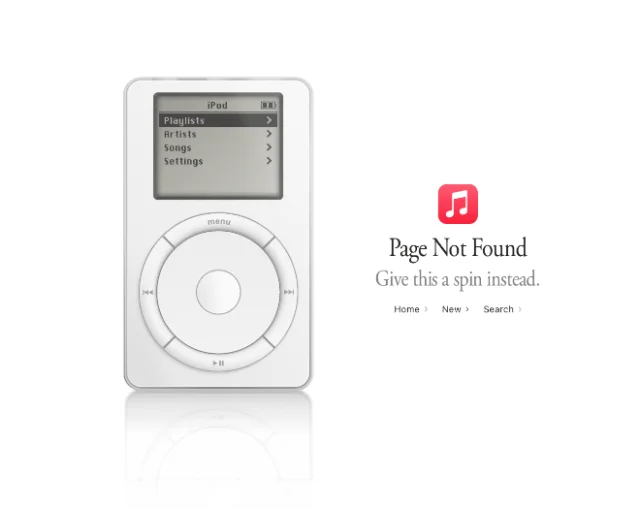

Apple has tucked a playable tribute to the original iPod into the Apple Music website, timed to the device's 25th anniversary on October 23, 2026. Type in a broken address under music.apple.com and you get a working recreation of the first-generation iPod instead of the usual error page. It's a small joke with a lot of nostalgia packed into it, and it's worth a look if you still have a soft spot for that white slab and its click wheel.
What the 404 page actually does
The trigger is simple. Visit music.apple.com/404 or any random path that returns a not-found response, and the page shows a detailed virtual iPod with a monochrome screen and the prompt "Give this a spin instead." No login, no subscription, no download. It's a plain web page, and that's the point: the tribute lives where most people would only ever see a dead link.
Easter eggs on error pages have a long history on the web, and they tend to work for the same reason this one does. Nobody expects to find anything there, so a discovery feels personal. Here, the recreation is substantial enough that people will likely spend a few minutes with it rather than bouncing straight back.
How the virtual click wheel behaves
The interaction model is the most convincing part. On a desktop you can click the wheel with a mouse, or use the arrow keys and Enter. On a touchscreen you can swipe around the wheel. The menus mirror the original hardware: Playlists, Artists, Songs and Settings, with shuffle, repeat, a backlight timer and clicker sounds that imitate the tactile feedback of the real thing. If you grew up scrolling a physical wheel with your thumb, the rhythm of the clicks will feel familiar within a few seconds.

The clicker sounds matter more than they sound like they should. Much of what made the original iPod feel solid was the audible and physical response to each step through a list, and reproducing that in a browser is harder than it looks. Apple has clearly spent time on the details rather than just dropping in a static image.
The library and its limits
The virtual library holds more than a thousand tracks, leaning heavily on early-2000s hits. Britney Spears, Coldplay, Alicia Keys, Eminem and Foo Fighters are among the artists named, and the mix captures the era the first iPod was selling into. It's a useful reminder of how much of the device's appeal was tied to the music people were actually loading onto it.
Playback is restricted to standard preview clips. Longer songs play for about 90 seconds and shorter ones for about 30 seconds. That's a sensible limit for a free, login-free experience, and it means you won't be listening to full albums here. Think of it as a sampler rather than a player. The experience also runs only in a web browser and doesn't appear inside the Apple Music app on Mac, iPhone or iPad, so don't expect it to show up in the app's own interface.
The Brick game hidden inside
There's a second layer for anyone who pokes around. Open Settings, choose About, and hold the center button for roughly five seconds. That launches Brick, a Breakout-style game. Brick was a hidden feature on the original 2001 iPod, so this is a faithful callback rather than a new addition. It's a neat touch that the tribute reaches back into the hardware's own hidden extras.
The game also connects to a longer thread of Apple history. Breakout was developed in the 1970s, and Steve Wozniak and Steve Jobs contributed to it during their time at Atari. Seeing a Breakout clone tucked inside an iPod tribute on Apple's own website gives the joke a little extra weight for anyone who knows that backstory.
Why the date matters
October 23 carries its own symmetry. Steve Jobs introduced the original 5 GB iPod on October 23, 2001, at Apple's Infinite Loop campus, and promised "1,000 songs in your pocket." The device went on to reshape portable music and, in the view of many observers, set the stage for the iPhone and the streaming services that followed. The tribute page makes that promise literal: there are more than a thousand songs, just not in your pocket.
Apple discontinued the last iPod models in 2022, so this is a revival with no hardware attached. That's what makes it interesting to me. The company isn't selling anything here. It's using a web page nobody was supposed to land on to remind people where a lot of today's habits started.
What to watch next
Whether this stays up is an open question. Apple hasn't said whether the iPod recreation is permanent or a one-day anniversary stunt, and the page is easy to miss if you don't already know the trick. If you want to see it, the safest move is to try the 404 route yourself before the anniversary window closes. And if you're the kind of reader who keeps an old iPod in a drawer, this is a decent excuse to plug it in, or at least to remember why you liked the click wheel in the first place.