First day cover ·
Apple's iPhone Duo Could Take a Quarter of the Foldable Market
TrendForce projects Apple's iPhone Duo will hold about 24.8% of foldable shipments in 2026, nearly tying Huawei for second behind Samsung.
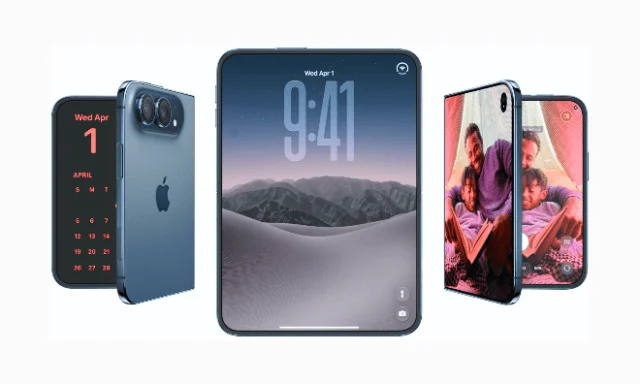
Apple's first foldable is selling fast enough to change the shape of the category. TrendForce projects the iPhone Duo will ship about 5 million units this year, which would give it roughly 24.8% of global foldable smartphone shipments. That's a big number for a market that isn't growing much, and it's the detail that matters most here.

A big share of a flat market
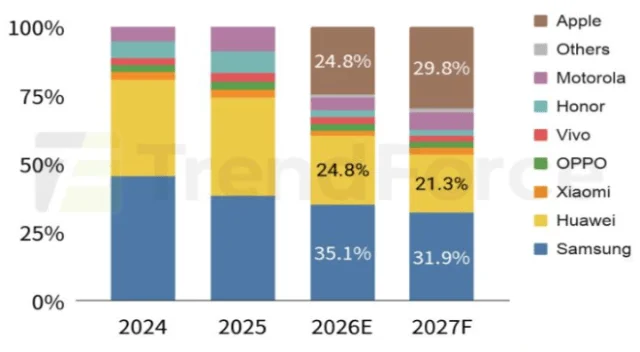
Here's the thing: TrendForce expects global foldable shipments to rise only 0.5% in 2026. Against that flat backdrop, a single new model taking nearly a quarter of units means other brands are giving up ground. The firm estimates that Android brands excluding Apple will see combined shipments fall by more than 20% year-over-year, with rising component costs cited as a major pressure.
Samsung remains the leader in the firm's projection, at roughly 35.1% share on about 7.1 million units. Apple would land in a near-tie with Huawei for second place. That's a notable jump for a company that had no foldable in the category until now. The volume itself stays nearly stagnant, so this is a realignment of who gets the sales, not a sudden expansion of the category.
Demand is running ahead of supply
The early signals on purchasing are strong. Less than a week after preorders opened, Apple's website showed delivery windows stretching into January 2027 for some orders. For a first-generation foldable from a company new to the form factor, that's a striking sign of pent-up interest. My read is that buyers who wanted a foldable but weren't convinced by earlier models are now willing to wait for Apple's version.
User feedback is more mixed. Owners have singled out the expanded viewing area and split-screen multitasking as the features they appreciate most. Those are the benefits that a bigger canvas is supposed to deliver. The complaints are less about the hardware concept and more about how well the device's software and apps take advantage of it, which I'll come back to.

Hiding the crease is harder than it looks
One of the Duo's most discussed features is how faint its display crease is. A foldable OLED panel is a stack of layers: cover materials, adhesives, display elements and encapsulation. Each one responds differently when the phone bends, with some layers stretching, others compressing and some sliding against their neighbours. TrendForce's analysis says Apple has tuned the bending radius, the thickness of each layer, the stiffness of the materials and the controlled slippage inside the adhesive stack. The goal is to reduce strain and help the panel recover when the phone opens.
The optical side matters too. According to the firm, nanoscale surface textures scatter reflected light so the residual fold line is less noticeable. That's a useful reminder that a crease is partly a physics problem and partly a visual one. Two phones with identical folding mechanics can look very different depending on how light hits the surface.
The teardrop hinge does a lot of the heavy lifting. When the phone is open, it keeps the display flat and stable enough for reliable touch input. When closed, it creates the clearance the panel needs to fold along its intended curve. Get the hinge wrong and the other engineering work doesn't matter much, which is why it's a good place to look if you want to judge a foldable's long-term durability.
Software is the harder problem
A bigger screen only pays off if apps use it. TrendForce notes that the Duo's wider workspace is meant to support side-by-side document reading, AI-generated summaries and content editing. To do that well, apps have to reflow their layouts as the device opens and closes, while keeping the user's place in the content. Some applications still show black borders or leave large parts of the screen unused. That tells me developers haven't caught up with the hardware yet.
Power is the other constraint. A larger OLED panel uses more energy, and the firm points out that even static white-background content keeps drawing power for light emission. Lowering the refresh rate doesn't solve that. Balancing multitasking, on-device AI workloads and battery life will depend on more efficient emissive materials, better optical structures and smarter adaptive driving of the display. Those are the areas to watch in future foldables from every brand, not only Apple's.
Where this goes next
TrendForce says Apple's core advantage is its tight integration of silicon, operating system and developer ecosystem. If app compatibility improves and the hardware reliability issues the firm mentions are resolved, the Duo could shift the conversation away from novelty and toward how efficiently a foldable handles multitasking. That's a more useful comparison for buyers, and it's where I'd focus when reading reviews.
Secondary coverage of TrendForce's outlook has pointed to Apple's share rising to around 29.8% in 2027, as the broader foldable market recovers. Those figures are forecasts, and they depend on execution. Treat them as a direction of travel rather than a settled number.
For most people, the practical question is simple. If you already own a foldable, watch whether your favourite apps adapt to the bigger canvas. If you're waiting for a first foldable, the delivery queue suggests you'll want to decide early, and the software support you find in the first few months will tell you more about the Duo's value than the hinge will.