First day cover ·
PC Shipments Dropped 20% as Memory Costs Climbed, and Windows 11's AI Pitch Isn't Moving Buyers
Q3 2026 PC shipments fell about 20% as memory and storage costs pushed prices up. Windows 11's 26H2 and RAM work may matter more to buyers than AI.
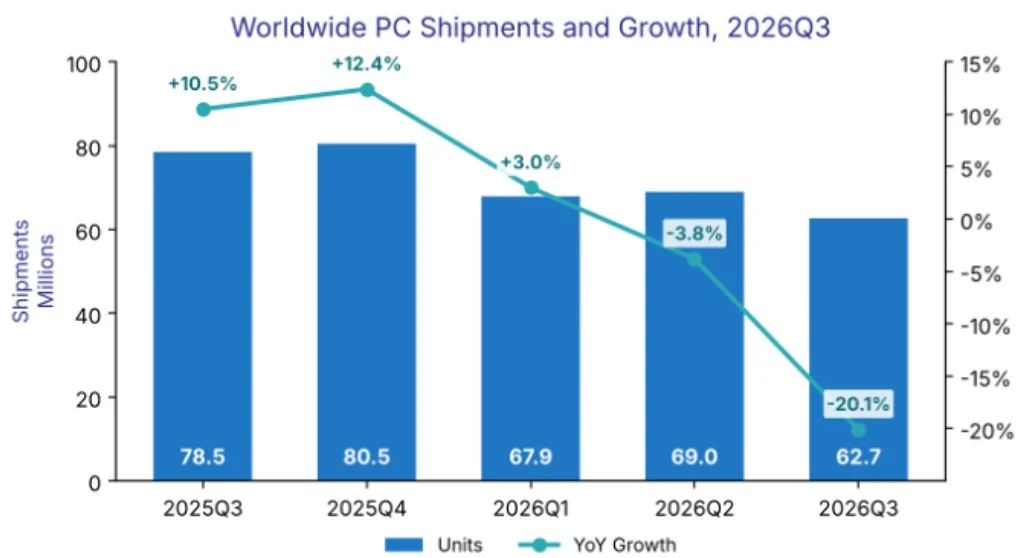
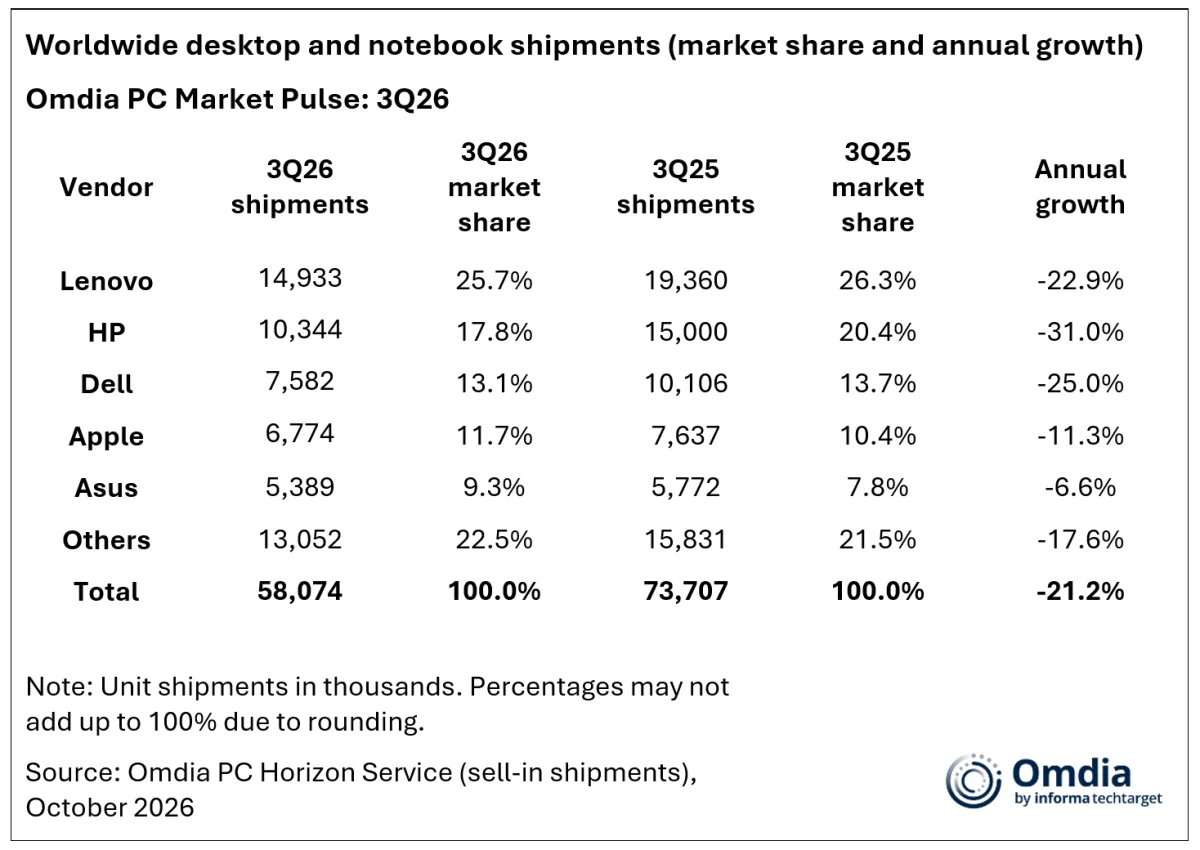
The PC market had a bad quarter, and the cause isn't hard to find. Omdia estimates worldwide desktop, notebook and workstation shipments fell 21.2% year-over-year in Q3 2026, while IDC puts the drop at 20.1%. Both trackers agree on the direction and the reason: prices inflated by memory and storage costs turned buyers away, and PC makers had already stocked up early in the year. Even Apple shipped 11.3% fewer Macs, according to both firms.
A quarter that broke the usual pattern
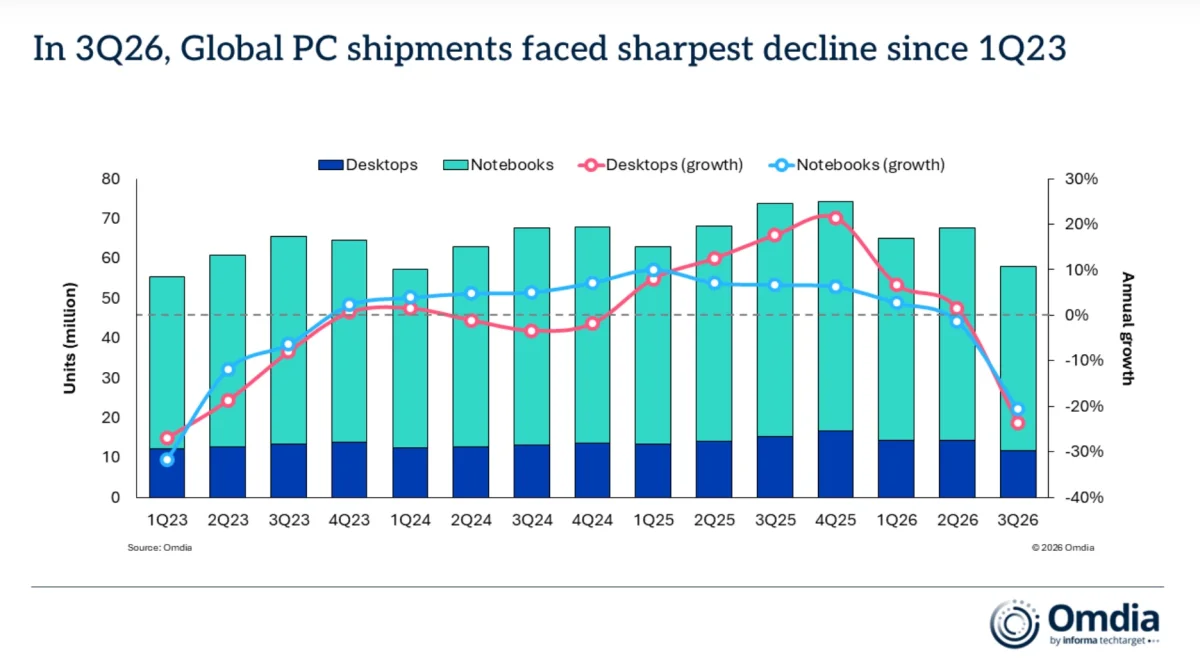
Q3 is normally the bigger quarter. This year it came in below Q2. IDC says shipments dropped 9.1% from 69 million units in Q2, and it's the second straight year-over-year decline after Q2 slipped 3.8%. Omdia puts Q3 at 58.1 million units, down from 73.7 million a year earlier, which it calls the steepest annual decline since Q1 2023. IDC's figure is 62.7 million, down from 78.5 million. The numbers differ because each firm runs its own tracker, but they land in the same place.
Omdia's breakdown shows the damage by category. Desktop shipments fell 23.5% to 11.7 million, and notebooks dropped 20.6% to 46.4 million. Vendors and their ODM partners began cutting production in Q3.
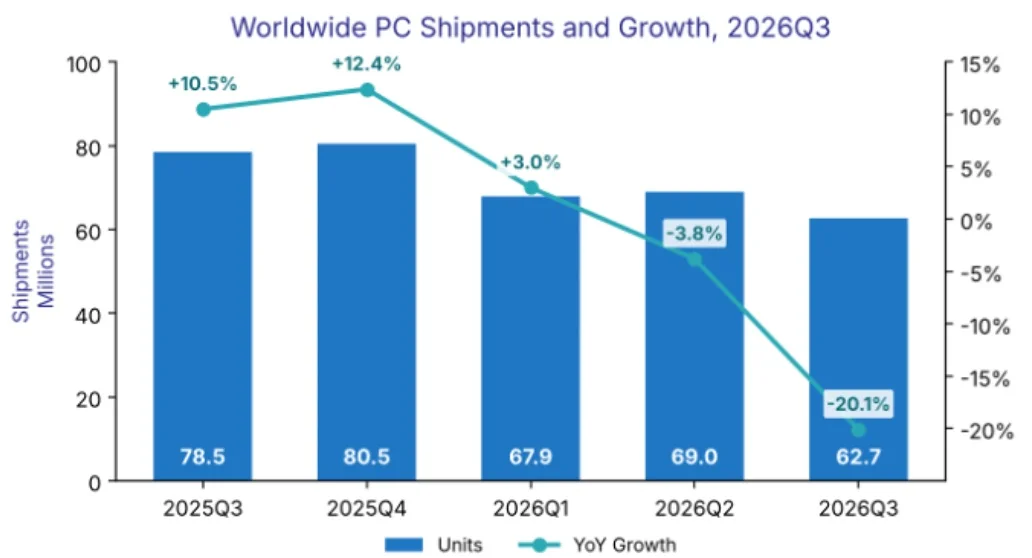
The self-inflicted part is what stands out to me. OEMs and channel partners bought heavily in the first half of 2026, probably to get ahead of price hikes. That pulled demand forward, and by Q3 there wasn't much left. IDC's Jitesh Ubrani, research director for consumer devices, put it this way: "Vendors and channels loaded up on inventory early in the year to get ahead of price hikes, and that has thrown off the usual seasonality, where Q3 is typically larger than Q2."
Memory and storage are eating the price of a PC
Omdia's Ishan Dutt says leading OEMs had already forecast double-digit declines for the second half, and retailers reported double-digit jumps in average selling prices alongside falling sales. His read is that the component cost increases have now fully reached shelf prices. "The impact of upstream component cost increases has now fully worked its way through to end-market pricing, with consumers and IT decision-makers responding accordingly," he says.
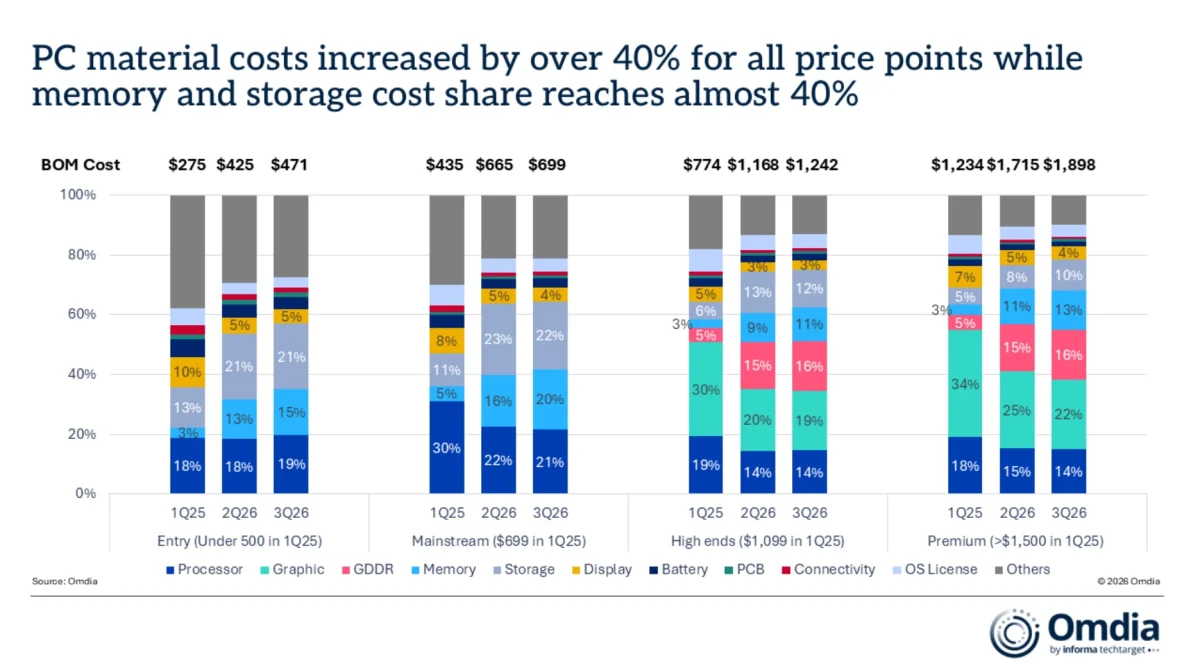
Ben Yeh, Principal Analyst at Omdia, puts the scale in numbers: DRAM and SSDs have grown from a typical 15% share of PC cost to nearly 40%, with price increases of more than fourfold.
Omdia's model of a mainstream PC that sold for $699 in Q1 2025 makes this concrete. Total parts cost rose from $435 to $665 by Q2 2026 and reached $699 in Q3 2026. Memory and storage combined went from roughly $70 to $294 over the same period. That accounts for about $224 of the $264 increase in parts cost. Processors, by contrast, dropped from 30% of parts cost to 21%.
| Mainstream PC ($699 in Q1 2025) | Q1 2025 | Q2 2026 | Q3 2026 |
|---|---|---|---|
| Total parts cost | $435 | $665 | $699 |
| Memory share of parts cost | 5% | 16% | 20% |
| Storage share of parts cost | 11% | 23% | 22% |
| Memory and storage combined (approx.) | $70 | $259 | $294 |
| Processor share of parts cost | 30% | 22% | 21% |
Premium machines aren't insulated, either. For some high-end configurations, the parts now cost more than the whole PC did in early 2025. Omdia's tier comparison shows parts costs rising between 54% and 71% depending on the tier:
| PC tier (retail price in Q1 2025) | Parts cost in Q1 2025 | Parts cost in Q3 2026 | Increase |
|---|---|---|---|
| Entry (under $500) | $275 | $471 | 71% |
| Mainstream ($699) | $435 | $699 | 61% |
| High-end ($1,099) | $774 | $1,242 | 60% |
| Premium (over $1,500) | $1,234 | $1,898 | 54% |
These are component costs only. Assembly, shipping and the maker's margin sit on top. Memory isn't the sole pressure point, either. Omdia says shortages of processors, graphics cards and other chips are complicating inventory planning, and in high-end and premium machines, graphics memory (GDDR) rose from 5% to 16% of parts cost. Yeh notes that PC makers have raised prices several times, but those increases "have yet to fully offset the impact."
Who held up and who didn't
Lenovo, HP, Dell, Apple and Asus kept their places in Omdia's top five, but every one of them shipped fewer units. HP lost 2.6 points of market share in a single year, the steepest fall among the group. Apple's shipments dropped 11.3%, yet it still gained share, which Omdia attributes to its premium positioning softening the effect of higher prices. Asus had the smallest decline among the top five.
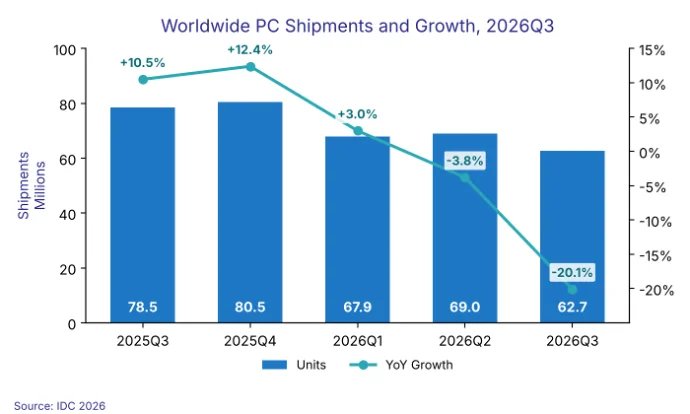
IDC's numbers tell the same story. Lenovo, HP and Dell fell faster than the market and together gave up 4.2 points of share, while Asus dropped the least, at 8.6%.
Discounts are coming, but not back to 2025 prices
Channels are sitting on inventory, so promotions are likely. Ubrani says that could bring some short-term relief, but he doesn't expect prices to return anywhere near last year's levels. "We don't expect pricing anywhere near what it was a year ago. Prices will remain elevated," he says. He also warns that with macro conditions worsening, "the risk is that the outlook for the next few quarters gets worse before it gets better."
Omdia expects shipments to fall another 24% year-over-year in Q4 2026 and 7% in 2027. Yeh's view is blunter: "the current decline may be just the beginning of a new downward cycle."
Windows 11 is getting better, which may be the more useful news
Microsoft promised in March to fix Windows 11 after a rough 2025 of problematic updates, and Satya Nadella repeated that commitment in July. The results are showing up in smaller ways. In hands-on testing, a three-year-old 16GB laptop used up to 2GB less RAM after a restart on Windows 11 26H2, and apps opened noticeably faster.
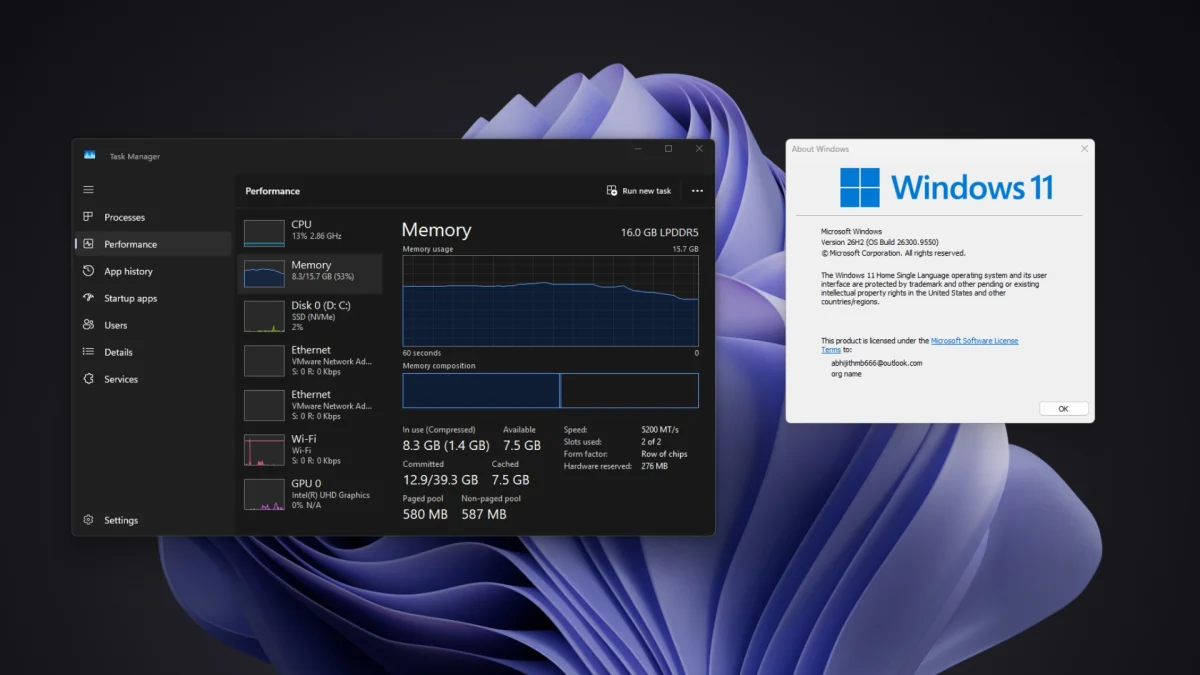
The July update sped up shutdowns and File Explorer. The September update lets users remove web results from Search, which made it much quicker in testing. Microsoft is also trying a Search rebuilt on WinUI 3, and the latest experimental WinUI release added table and chart controls along with a memory fix. Developers have leaned on web wrappers for years because native Windows toolkits lacked basics, so that's a meaningful change.
The bigger promise is optimizing Windows 11 for 8GB PCs by the end of 2026. Windows chief Pavan Davuluri tied that work to the rising cost of memory. Some OEMs are bringing 8GB laptops back, but one 8GB owner reported RAM usage still at 96% on 26H2. My read is that the 8GB optimizations haven't fully shipped yet. If they do, budget laptops could finally feel usable. Faster software doesn't make DRAM cheaper, though. It mostly gives people another reason to keep their current PC longer.
Local AI needs memory, and memory is the expensive part
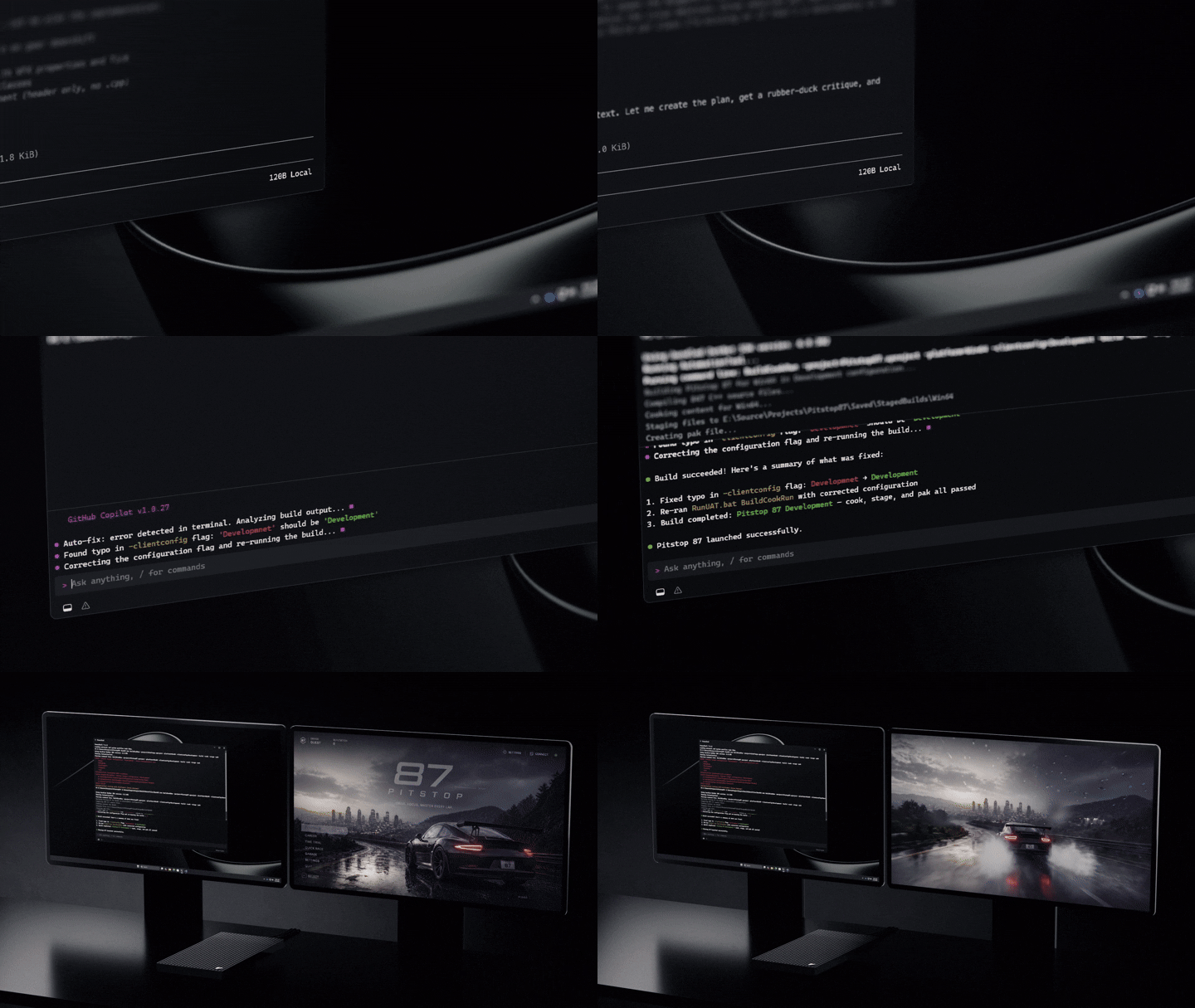
IDC blames the higher prices on the "AI data center build out." Microsoft's first big Windows event in two years, held October 7, spent much of its time on AI. Its hybrid intelligence pitch is more nuanced than before. Davuluri says Windows will run AI on your PC "where it makes sense" and use the cloud "when it needs to." Every task that runs locally is one less request for a data center, which is a sensible idea on paper.
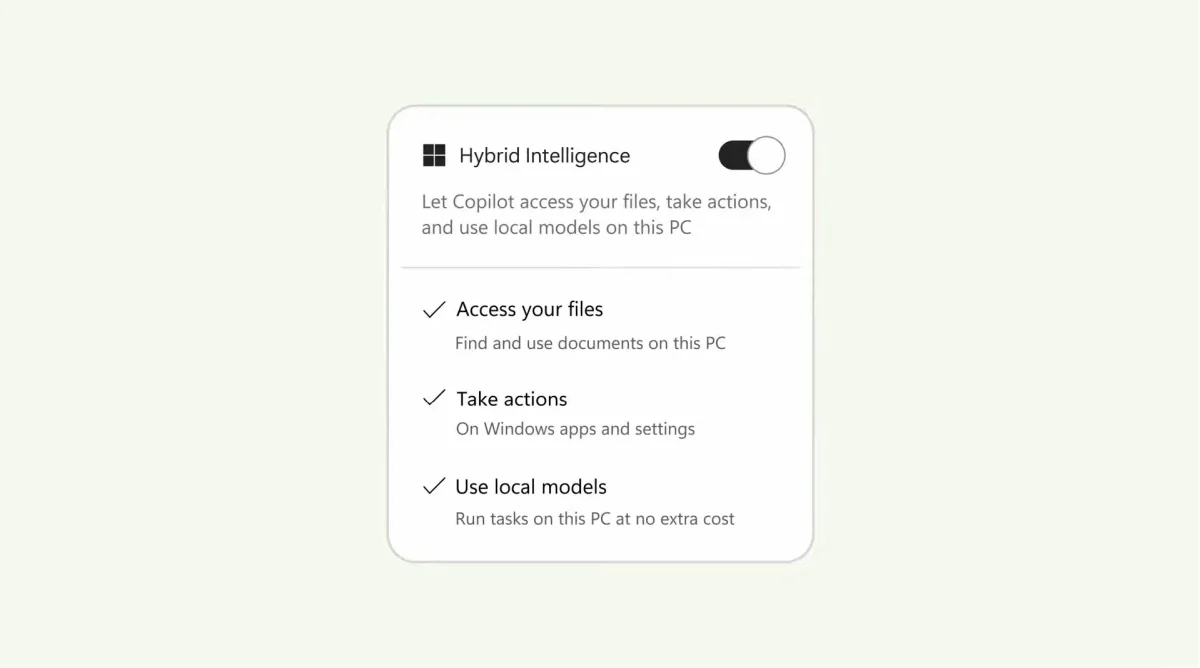
Local AI, though, needs a lot of RAM. The Surface Laptop Ultra starts at $2,599.99 with 24GB, but Microsoft's AI benchmarks used the 64GB model, which costs $4,299.99. A 128GB version is listed at $5,899.99. ASUS's ProArt P14 reaches about $6,500 with 128GB. I suspect Microsoft or NVIDIA is absorbing some of that cost, or the pricing is introductory. Either way, it isn't a mainstream price.
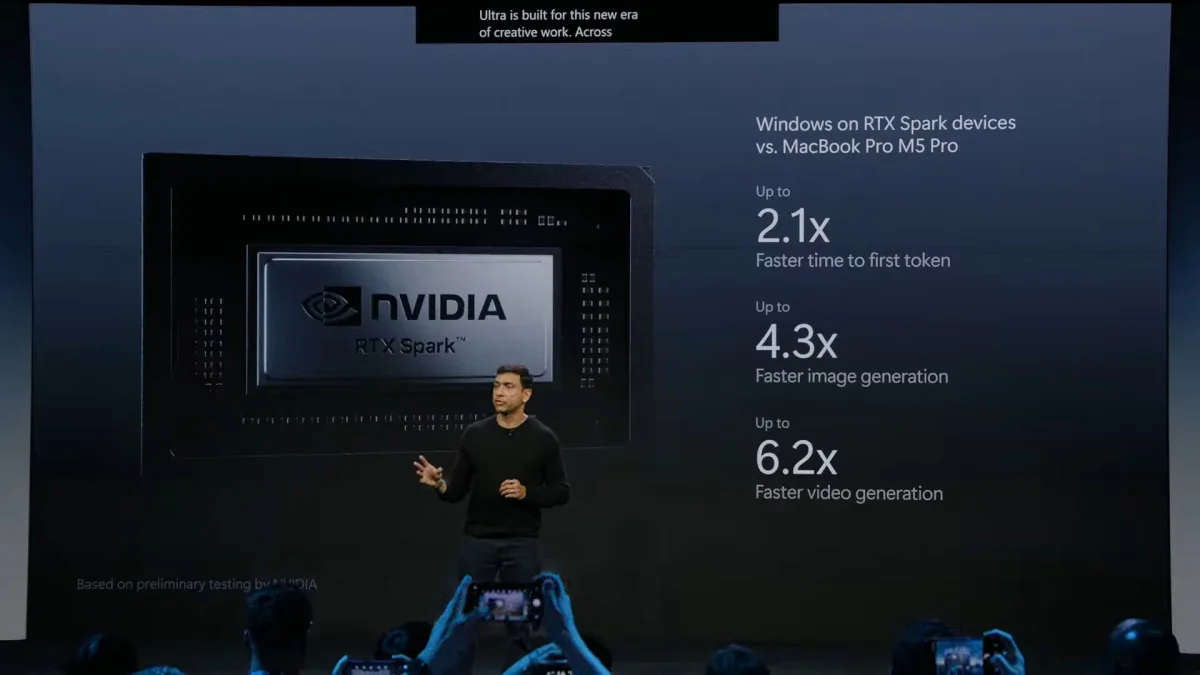
The Surface RTX Spark Dev Box costs $5,999 with 128GB, which is more than the laptop. It includes an extra 1TB of storage, but it has no display, keyboard or battery.
Buyers need a reason to upgrade before AI matters
Apple has Apple Intelligence, Windows 11 has agents, and shipments are down for both. My take is that PC makers and Microsoft confused their own enthusiasm for AI with what buyers want. AI PCs were supposed to kick off an upgrade wave. Instead, people are holding onto what they have, and the price of memory is the reason more than the feature list.
Windows 11 is finally getting the basics right. What the industry needs next is a PC that handles everyday work well at a price people can pay, with AI as a bonus rather than the headline. Watch the 8GB optimization work and the next round of pricing. Those will show whether the market can recover.