First day cover ·
Smartsheet's vsActual Aims AI Agents at Executive Strategy Drift
Smartsheet's vsActual uses AI agents to flag budget overruns and schedule drift. Early access now, general availability planned for early 2027.

Smartsheet has moved its AI ambitions up a level. Its new vsActual application is aimed less at the project manager updating a task list and more at the executive who needs to know whether the company's strategy is still on track. It's a standalone "AI-native" product, separate from the core work management platform, and its agents are designed to watch for the gap between what leadership planned and what's actually happening.
What vsActual actually does
The product pulls data from a range of business systems, including Oracle, Salesforce, SAP and Workday, alongside work management tools such as Smartsheet itself. Its agents can run on a natural language prompt or work in the background without being asked.
Smartsheet has split the work across several agents. An intake agent reads existing material, such as presentation decks and spreadsheets, and builds what the company calls a "plan of record," covering goals, timelines, and budget and capacity limits. A planning agent handles capacity planning and scenario modelling, and it can be called back in when a plan has to change.
The drift agent is the one to watch. It runs continuously, looking for signals such as budget overruns, schedule delays, and resource conflicts. To find them, it analyzes information from connected applications, and Smartsheet says that includes conversations in Slack. When it spots a problem, vsActual can recommend a corrective step, such as moving more staff onto a project that's trending toward a delay.
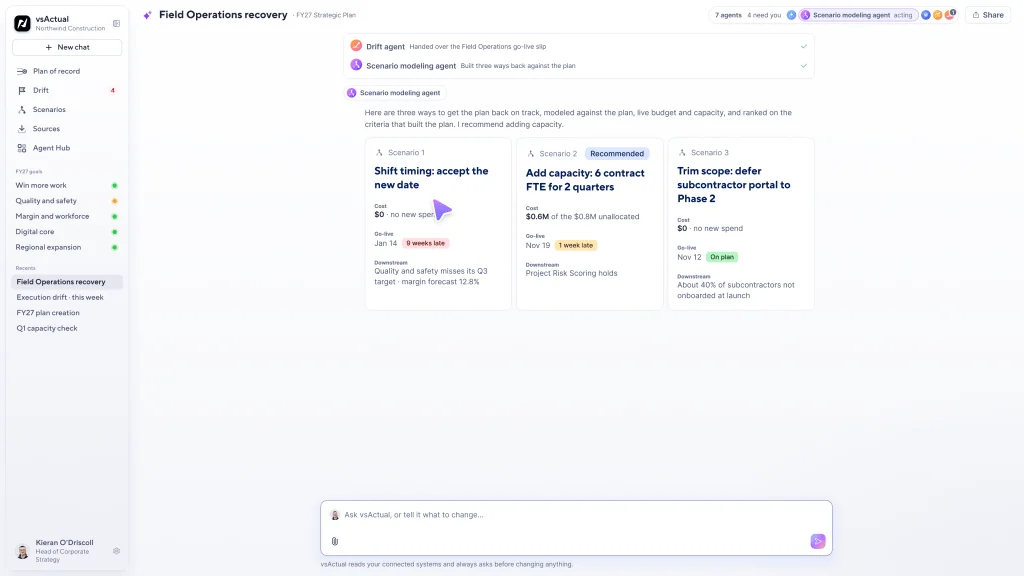
Two more agents round out the set. A data quality agent checks the inputs, and a reporting agent keeps users informed about changes across projects. That's a practical detail, because an agent that flags drift is only as useful as the data feeding it.
Why "execution drift" is the real pitch
Smartsheet's term for the problem is "execution drift," the distance between a strategy on paper and the outcomes a business is actually getting. Liz Miller, vice president and principal analyst at Constellation Research, says that gap is a familiar one for executive teams. It tends to surface only during quarterly planning sessions, usually in PowerPoint slides, or in Excel files passed around by email. By the time it's visible, the budget has already crept and the timeline has already slipped.
That's the case vsActual is making. Rather than waiting for a review cycle, it tries to catch the drift early and put a recommendation in front of the people who can act on it. Miller describes the approach as proactive, with the tool "hunting for drift" and raising recommendations tied to the operating context of the business. She names the CFO and COO as the core audience, since those are the roles most often dealing with budget creep and timeline slippage.
The Execution Graph underneath
The engine behind this is Smartsheet's Execution Graph, a knowledge graph that maps how an organization's tasks, projects, and strategic goals relate to one another. That structure matters more than the agent branding. A recommendation to add headcount to a delayed project only makes sense if the system understands which project depends on which goal, and what resources are already committed elsewhere. Smartsheet says the scenario recommendations are grounded in live project and business data, with business context coming from the graph.
Competing tools exist in this space. Miller points to strategic planning, financial operations, and OKR tracking applications that pull in strategy data. Her critique is that many of them remain tethered to a primary system, such as an ERP or HCM platform, and fall short of building workflows that actually recommend or take action. vsActual's bet is that the action layer is the differentiator.
Autonomy, with a human in the loop by default
The agents can act on their own. When given the right permissions, they can update data in third-party applications. Smartsheet says human approval is required by default, which is the sensible starting point for any organization handing write access to an AI system that touches budgets and staffing.
Miller's advice is to treat that default as a floor. Before an agent is assigned tasks autonomously, she argues, an organization should set guardrails and processes to confirm the agent has been "tested, trained, and grounded." She also stresses that people need clear ways to step in and exercise judgment when the agent's output looks wrong. Her broader point is that an AI system is only as accurate as the data, prompts, and guardrails it runs within, and that holds even more when the subject is a company's strategy.
A bigger shift than the feature list suggests
Smartsheet has been adding strategic planning features to its core platform for a while. Scenario modelling and portfolio tracking tools arrived at last year's Engage event. vsActual is different in kind. Keith Kirkpatrick, vice president and research director at The Futurum Group, calls it the company's clearest move yet from managing tasks to governing strategy, budget, and capacity. He also says the Engage keynote demo made a strong case for it.
Kirkpatrick's caveat is the more useful one for buyers. Smartsheet's customer base has traditionally grown from the bottom up, through project managers and operations teams. vsActual pushes toward senior executives and strategy offices, which means a different buyer and a different sales motion. In his words, the concept is sound, but the launch asks Smartsheet to sell to a new buyer and to sell a product unlike the one it's known for.
Availability and what to watch
vsActual is in early access now, with general availability planned for early 2027. Smartsheet hasn't disclosed pricing, but it has confirmed usage-based billing. For organizations weighing it, that makes the cost hard to estimate until the company publishes specifics, and it's worth modelling how usage might scale across many projects and agent runs before committing.
My read is that the questions that matter most aren't about the agents themselves. They're about data integration depth, how cleanly the drift alerts can be tuned to avoid noise, and whether finance and operations leaders will trust a recommendation enough to act on it. If Smartsheet answers those well during early access, vsActual could make the quarterly slide deck feel like a much older way of running a business.