First day cover ·
Box Architect Turns Plain-Language Goals Into Document Workflows
Box's new Architect tool builds document workflows from plain-language goals. It enters beta in Q4 2026 for Enterprise Advanced customers, with pricing still undisclosed.
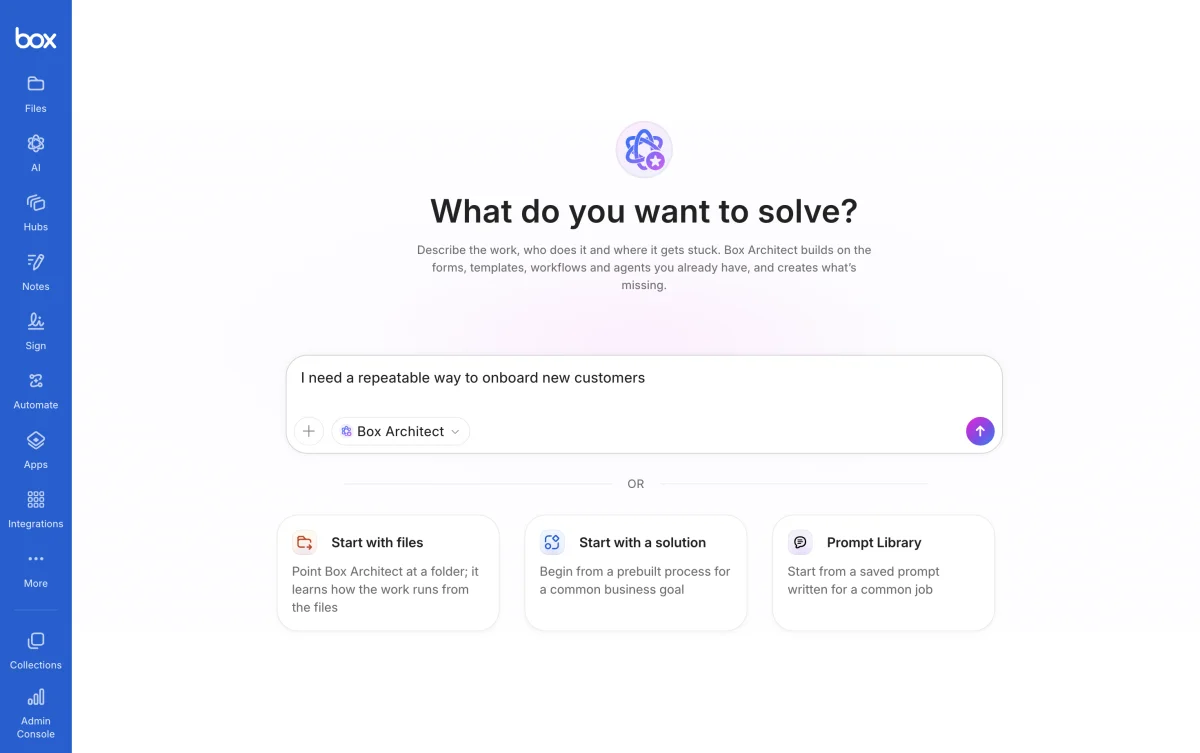
Box is betting that the hard part of workflow automation isn't the plumbing. It's getting the process written down in the first place. Architect, announced at BoxWorks 2026, tries to close that gap by letting people describe what they want to automate in ordinary language and then building the workflow around it. If it works as described, the people who benefit most won't be the ones who already script their own automations. They'll be the teams that know how work gets done but have never had the time to model it.
How the workflow gets built
The starting point is a plain-language description of a goal or process. From there, Architect works out the stages and decision points the workflow needs. Box says it applies the permissions, classifications and retention policies already attached to the content in Box, so a workflow doesn't quietly bypass the access controls a company has set up.
Before anything goes live, users can test the workflow. They can also add checkpoints that require a person to review or approve a step. That matters more than it sounds. Most automation projects stall when someone realises an edge case was never modelled, and a test run with human sign-off gives teams a place to catch that before it reaches real documents.
Once a workflow is deployed, Architect keeps watching its outputs and suggests changes as the workflow runs. Box describes this as continuous improvement, which is a reasonable thing to expect from a tool that's meant to sit inside a process rather than be set up once and forgotten.
Where it fits in the wider Box toolkit
Architect isn't a standalone product. It coordinates several existing Box tools, and Box uses a bank's client onboarding process as its example. Applications come in through Box Forms. Box Extract checks the documents. Box Sign handles the agreements. Box Automate starts the account setup once those steps clear.
Here's the thing: that kind of chain already exists in many organisations, but usually as a set of separate tools glued together by handoffs, shared inboxes and someone's spreadsheet. The pitch for Architect is that the glue becomes part of the workflow itself, generated from a description rather than assembled by hand. Whether that holds up depends on how cleanly the tools hand data to one another in real deployments, and that's something the beta will need to show.
Who the analysts think it's for
Jason Andersen, vice president and principal analyst at Moor Insights & Strategy, reads Architect as a shift in emphasis. In his view, the tool is less about making one person more productive and more about capturing the collective knowledge of a team or business in a form that agents and workflows can use. That's a different value proposition, and it points at operations and shared processes rather than individual desktops.
Andersen also flagged the caveat that comes with any AI system touching business data. Customers still need to evaluate how their workflows actually perform. He recommends keeping humans involved while workflows are being created, and using observability tools to confirm that agents behave in line with the risk and cost limits a business has set. Those are sensible guardrails, and they apply whatever vendor sits behind the tool.
Availability and pricing
Architect is scheduled to launch in beta in Q4 2026 for Box Enterprise Advanced customers. Box hasn't disclosed pricing for the tool. Enterprise Advanced is the company's highest tier, and it includes an allocation of 20,000 AI Units, which Box uses to measure consumption of certain Box AI features. Anyone budgeting for Architect should treat that allocation as the only pricing detail on record for now, and ask how Architect's usage would draw against it once the beta opens.
A new Context Retrieval engine
Alongside Architect, Box introduced a Context Retrieval engine aimed at the agents that read from its content. CEO Aaron Levie said on X that the engine should "deliver better results for agents" connecting to documents stored in Box, and CTO Ben Kus described it as designed to find and deliver more relevant enterprise context to AI agents.
The engine is built on Nvidia's Nemotron Retriever open model. Kus said that foundation supports faster indexing and lower latency. On the technical side, it uses multimodal indexing across documents, images, audio and video. It also combines keyword and semantic search, which matters in practice because people rarely search using the exact words that appear in a document. A query for "termination clause" should still surface a contract that says "ending the agreement," and a hybrid approach is the usual way to get that behaviour without flooding results with noise.
Permissions carry over too. Context Retrieval applies the access rules already in Box, so an agent can only pull back material the requesting user is allowed to see. For any company where document access is tightly controlled, that's the detail that decides whether an agent is usable at all.
What the numbers say, and what they don't
Kus reported results from Box's internal testing. The tool produced a 20% improvement in search accuracy and what he called "fourfold faster question-answering." He also said it cut the number of tokens sent to downstream models by up to 90%. Those are the company's own figures, from its own tests, and they haven't been independently verified. Still, token reduction is the number that matters most to anyone paying for model usage, because it maps directly to cost.
Andersen sees the broader trend as the more important point. He expects context retrieval systems to see wider adoption, arguing they're improving output accuracy and agent performance, which in turn should bring higher end-user satisfaction and lower costs. He also pointed to Box's use of an open-weight model from Nvidia as something that strengthens the value case.
His caveat is the one to remember. Getting the most from context management, he said, requires solid design principles and governance. Companies that treat the retrieval engine as a plug-in that solves accuracy on its own will likely be disappointed. The benefits depend on the work customers put in around it.
What to watch
The Context Retrieval engine is slated for general availability for Enterprise Advanced customers early next year, and Architect's beta follows in Q4 2026. Between now and then, the questions that matter are concrete: how Architect's workflows hold up on messy real-world processes, how the AI Units allocation gets consumed, and whether the retrieval gains Box measured internally show up in customers' own document sets. Teams already on Enterprise Advanced have a head start in planning for those tests. Everyone else should wait for pricing before deciding whether this fits.